Linearization of Single Variable Non-Linear function
Linearization is a way to approximate a non-linear function around a point. In the blog post, I’ll show an implementation of best linearization of an equation around a point using Newton-raphson method. Before proceeding further, please note the following.
- Newton raphson is better suited for monotonic functions or in the regions where monotonic behaviour is seen. Hence, my implementation is not ideal condition.
- Newton Raphson may not converge if the equation may achieve a horizontal or vertical slope before the required point.
Now, with that out of the way, let me show you cool function which I tried to linearize.
Codechef LECANDY
Formulation of Simple Optimization Problems - Euler Beam
This post is meant as an introduction into a simple graphical optimization problem using Python. Consider a simply supported (Euler) beam of uniform rectangular cross section. The objective is to minimize the weight of the beam. Breadth (b) and depth (d) are variable. Length is fixed. Stresses must be within safe limits and mid deflection should be $\le$1% of the span.
Converting Video to Matroska Format using ffmpeg
My primary use case of ffmpeg had been to reduce the size of the downloaded online lectures. The output format did not actually matter for those videos as it seemed that the humongous file size of Powerpoint screen recording seems to be due to absence of proper encoding (not sure though). The matroska or “mkv” is an Open Source container format for video files. It has many advantages about which you can read about in their FAQ page. Here is how you can convert a batch of videos in a particular format (mp4, in my case) to mkv using ffmpeg.
Visualization with Seaborn in Python
Seaborn is a high level visualisation tool built on top of matplotlib which enables us to work with dataframes easily. We will try to make use of this Automobile dataset and try to gain some information with the help of seaborn plots. This post will be an exploratory one.
Visualizing 1D & 2D FEM Basis Functions in Julia
The Finite Element Method (FEM) is a mathematical tool using for solving differential equations. It has been popularly used (also, initially developed) for solving elastostatics problems which is to find the displacement $u$ such that, $$ \sigma_{ij,j} + f_i = 0 \text{ in the domain }\Omega $$ To solve this, the domain $\Omega$ is split into finite sub domains $\Omega_e$ in which the solution $u$ is (usually) approximated by a polynomial of certain order which is governed by the regularity requirements of the weak form of above PDE.
Automate Daily Task with Bash and Cron
Here is a simple method in which I am automating the creation of “Tomorrow’s notes” for my Obsidian.md notes1. In a similar manner, any simple tasks that needs to be repetitively done daily can be done with the help of bash scripting and cron job.
Plotting Lorenz Attractor With RK4
One of the classical example of chaos is always the Lorenz attractor. No matter how carefully you choose the values, however close they are, the end result is always different. And the fact that this never intersecting, unique set of values are bound within a domain which looks like a butterfly links it uniquely to the famous quote,
Solving 2nd Order ODEs in Julia
The second order Linear Differential Equations can be solved using DifferentialEquations.jl package available in Julia repository. Here is an example problem being solved using Julia.
Consider a 4-degree of freedom undamped free vibration system as follows.
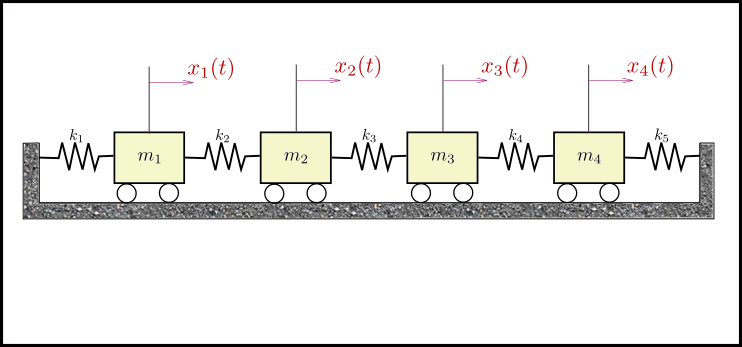
The above system can be represented by the equation,